2025 was a challenging year for Americans. Dissatisfaction with the cost of living dominated across nearly every group, regardless of political affiliation. Seven-in-ten Americans (70%) say they are displeased or very upset with changes in the cost of living in the last year. That number rises to 85% among the very stressed and remains a majority even among the thriving (51%). Only 15% of Americans overall say they are pleased with cost-of-living changes.
Angus Reid USA conducted an online survey from January 16 – 20, 2026, among a randomized sample of 1,838 American adults. Today, we’re diving into the data and unpacking the factors driving their discontent.
Wear on the Wallet
A little inflation is good for the economy. Last year, however, it continuously exceeded the 2% target, leaving 39% of Americans worse off than they were 12 months ago. That’s nearly double the 22% who say they are better off. Another 35% say their situation is unchanged, while 4% are unsure.
This deepening economic strain comes at a time when most Americans are already living paycheck to paycheck. Just 27% say they could handle an unexpected expense of more than $1,000 this month. The vast majority are unable to weather such an expense:
- 12% could manage up to $500.
- 13% could handle between $500 and $1,000.
- 19% could only handle up to $100.
- 15% say they could not afford any unexpected expense.

These findings raise the question: when so many Americans are unable to afford unexpected, in some cases life-altering costs—such as car repairs, medical bills, or household emergencies—is it a deficiency in our system? And what social programs should be in place, if any, to help bridge the gap?
Low Income. High Financial Stress.
It’s no surprise that low-income households have been hit hardest by inflation in the last year, though the sense of financial backsliding is felt across income brackets:
- $50K or less annual income: 43% say they are worse off, compared to just 16% who feel better.
- $50K – $99K annual income: 40% say they are worse off and 25% better off, while roughly one-third (34%) say they are about the same as last year.
- $100K or more: 31% say their finances have deteriorated over the past year.
And affordability isn’t the only challenge. For nearly half of Americans (43%), cost-of-living stress is compounded by concerns that they or someone in their household could lose a job because of the economy.
Dept also plagues Americans, with 43% saying they have too much. Notably, only 22% say they are never really stressed about money, underscoring the prevalence of financial anxiety even among those who are managing day-to-day expenses.
Party Anxiety
Income is a pervasive indicator of economic stress, but in 2025, so was political affiliation. Democrats are the most likely to be very stressed (38%), followed by Independents and others (30%). MAGA Republicans are the least likely to report high stress (17%), and the most likely to say they are thriving (29%).
Brighter Days Ahead?
Despite struggling in 2025, most Americans expect their economic situation to stay the same or improve in the next year:
- 33% say they expect to be better off one year from now.
- 27% say they’ll be worse off.
- 26% anticipate no change.
- 13% say they are unsure.
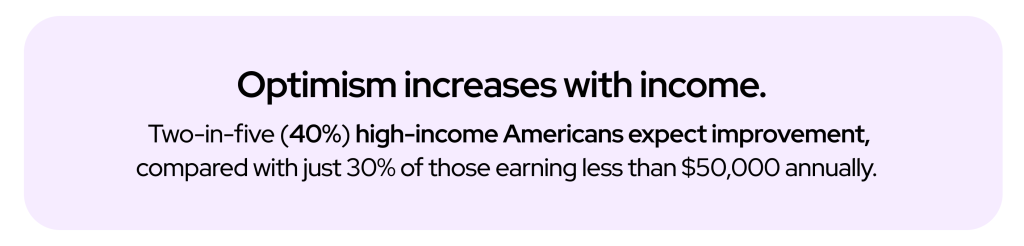
Still, even among lower-income households, optimism slightly outweighs pessimism, suggesting that while many feel bruised by the past year, a significant share is hopeful that their fortunes may improve.
Share your insights to influence the policies shaping America and get rewarded. Join Angus Reid USA and collect FREE gift cards for filling out polls and short surveys on the issues that matter most.