Tracking US sentiment toward the 2026 FIFA World Cup in the build-up to the big event
Source: Angus Reid Group, US Omni (fielded May 7-May 11, 2026)..
For this study, a nationally representative sample of n=1000 American Adults (age 18+ yrs.) who are members of the Angus Reid Forum was used. The sample frame was balanced and weighted on age, gender, and region according to the latest census data. For comparison purposes only, a probability sample of this size would yield a margin of error of +/- 2.5 percentage points at a 95% confidence level.
The headline: Most Americans are ambivalent, but Gen Z is ready for kickoff.
A year of buildup hasn’t translated into broader US engagement. As of early May 2026, 63% of Americans said they weren’t keeping up with World Cup content at all. Just over 1 in 3 (37%) have been following along in some form (e.g. social media, sports news/talk shows, sports apps or websites, etc.).
The audience keeping up with the event is disproportionately younger and male:
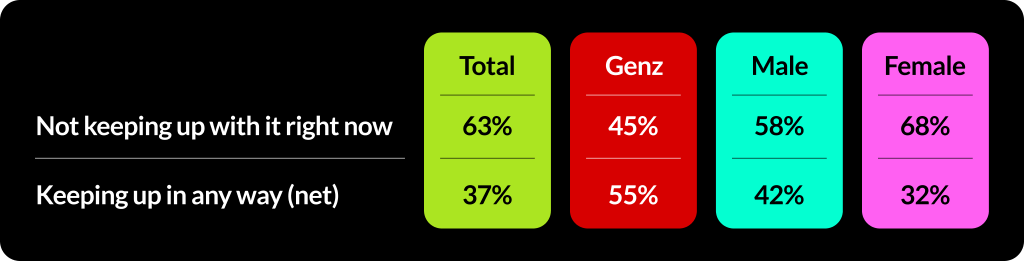
While over half of Gen Z (55%) is following the tournament, the gender gap is stark. Men are significantly more likely than women to both their general interest (38% men vs. 22% women) and desire to follow along (42% men vs. 32% women). The early World Cup audience in the US is, for now, a young male audience.
Only Gen Z has caught football fever.
Among Gen Z, 26% say they’re “very interested” in the 2026 FIFA World Cup – more than double the 12% national figure.
When asked how likely they are to engage once matches begin, Gen Z over-indexes on every behavior tested:
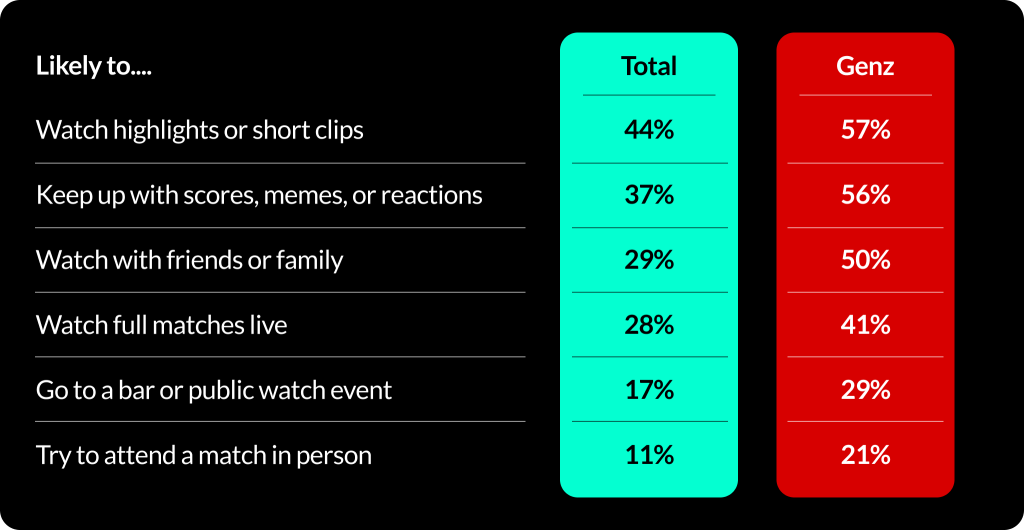
For Gen Z, the tournament is less about watching a full match and more about keeping up through social and easily accessible formats: highlights, memes, scores, and watching together. They intend to participate, but on their own terms: short-form, communal, and mobile-first.
That behaviour is already visible in how Americans claim to be following along. Among those currently doing so, social media and short videos are the single largest channel at 56% total, driven by Gen Z at 64% and Millennials at 63%.
So, how could FIFA boosts engagement?
Luckily for tournament organizers it seems that there’s still time to convince more Gen Z to embrace the beautiful game. When asked what would make them more interested, repsonses point to building more excitement easy access rather than the scoreboard:
Soccer is life! But for Gen Z, this tournament lives online
Gen Z’s are more enthusiastic and optimistic about FIFA, but their interests lay in how the tournament comes to life online and on social.
Taken together, the data points to a Gen Z audience whose interest is both stronger and more digitally oriented than the national average. They are more likely to see the tournament as a major U.S. sports moment, more likely to follow it than past World Cups, and more likely to expect social media to shape how it is experienced.
Love topics like this?
Join Angus Reid USA and be part of the conversation. Share your take on the issues shaping American life today through quick surveys, and earn FREE gift cards while you’re at it.